House restumping in Leongatha and the South Gippsland pages
For house restumping in Leongatha, South Gippsland Shire's pages give you a list of surveyors and a fee schedule but no restumping line. The Council's private building surveyors list says "you may use any appropriately registered practitioner of your choosing" and does not endorse anyone. It does not say who issues permits, and it does not mention restumping. The Council's 2026-27 fee schedule lists a building permit lodgement fee of $142.15. The surveyor sets their own fee, and no restumping-specific fee appears on any page we found. All of that was checked 6 November 2026.
So the permit question stays open for a house here. Ask a registered building surveyor, who is appointed by the owner or the owner's agent, and read our building permit guide for how the four councils compare. We are a referral service: we pass your enquiry to a builder who works in the district, and you ask which registration class they hold and check it on the Building and Plumbing Commission register.
Leongatha, Korumburra and Mirboo North at the 2021 Census
All three towns are overwhelmingly separate houses, which is why this page treats them together. The figures are ABS 2021 Census QuickStats for each suburb and locality, with small random adjustments. "Unoccupied" means unoccupied on census night.
| Place | People (median age) | Private dwellings | Separate houses | Owned outright | Rented | Unoccupied |
|---|---|---|---|---|---|---|
| Leongatha | 5,869 (45) | 2,750 | 94.9 per cent | 44.0 per cent | 22.6 per cent | 222 (8.4 per cent) |
| Korumburra | 4,749 (47) | 2,201 | 90.8 per cent | 42.0 per cent | 19.3 per cent | 213 (10.1 per cent) |
| Mirboo North | 2,263 (48) | 982 | 95.2 per cent | 47.1 per cent | 12.9 per cent | 75 (8.0 per cent) |
Leongatha had a median weekly household income of $1,183 at the 2021 Census, Korumburra a median weekly household income of $1,175 and Mirboo North a median weekly household income of $1,223. For the shire as a whole, ABS counts 30,577 people and 17,114 dwellings, with 95.5 per cent of occupied dwellings separate houses. The unoccupied shares here are far lower than on the coast, which fits a district where more houses are lived in all year, though the census does not say who owns them. It also gives no housing age.
Hill-country ground under house stumps
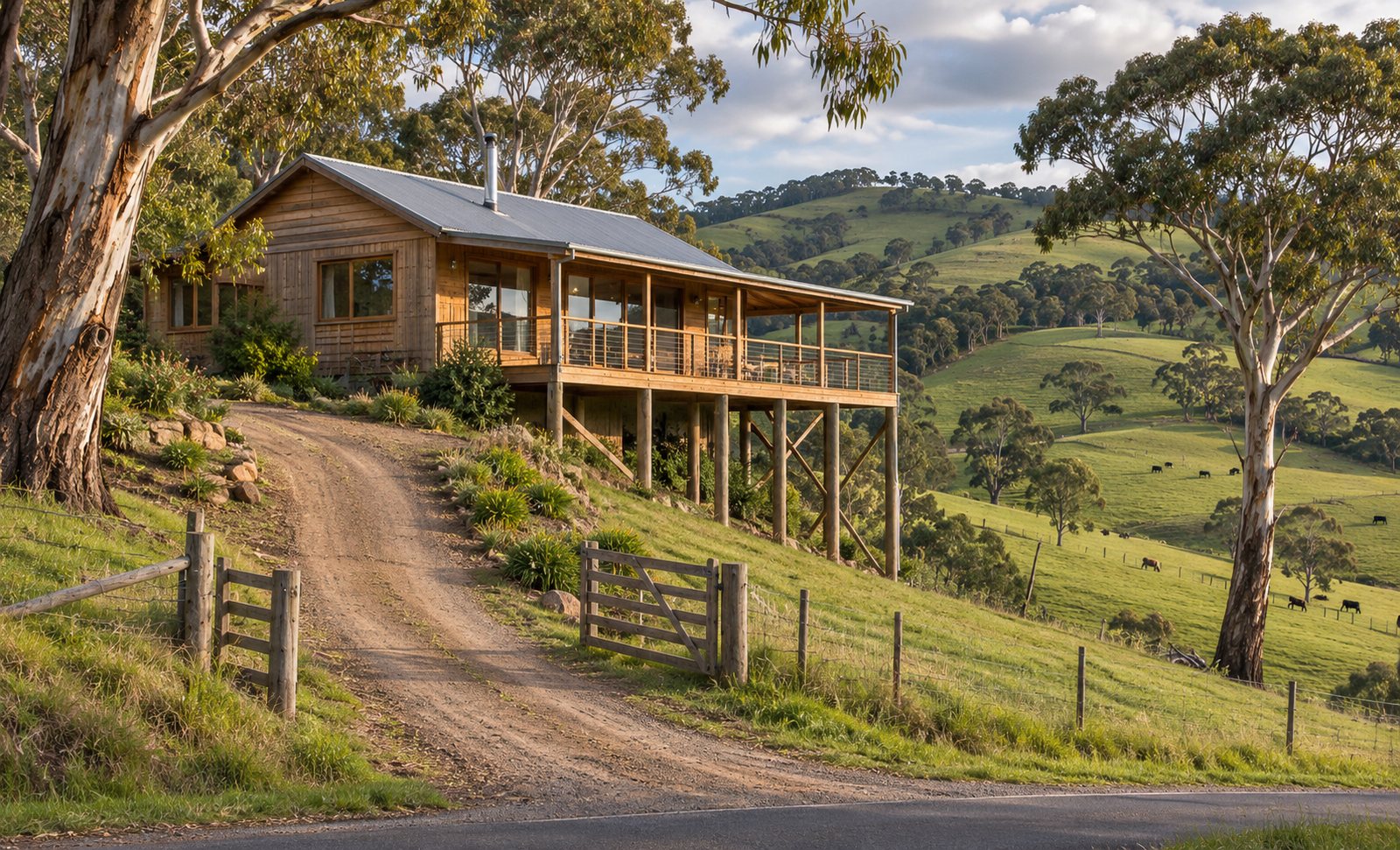
The agricultural soil description for the hills of South Gippsland is the best ground information we found, and it does not name these three towns. The Victorian Resources Online entry for the Strzelecki unit says the unit occurs extensively throughout South Gippsland, with slopes mostly 10 to 32 per cent and some 32 to 56 per cent. Soils on the slopes are clay loams grading to light and medium clays, drainage lines carry grey-brown sandy clay loams to clay loams over mottled light clays, and steep northern slopes are shallow. The page does not mention landslip.
That describes soil for farming, not a building site class, and it says nothing about shrinking or swelling. Only a soil test classifies a site. On a sloping block the downhill stumps can be tall, and one industry guide says adjustable galvanised steel stumps suit sloping sites. It names no Gippsland town. Our soils and subfloor guide sets out what the surveys cover, and the house underpinning page covers the case where the problem is the footing, not the stumps.
We fetched no weather station for Leongatha, Korumburra or Mirboo North, so this page gives no rainfall. Do not borrow a figure from another town.
Landslip updates are about roads, not houses
South Gippsland Shire's landslip update, dated 20 March 2023, is about road slips and should not be read as a map of house risk. The update (landslip page) says there had been six declared disaster events since 2021, with over 100 slips recorded and 50 fixed. It names priority slips on roads in several places, including two sites on Sanders Road at Korumburra. These are road repairs. The page does not mention house sites, and we found no landslip statement for any house in these towns.
If your block is steep, the sensible questions are for the surveyor and the builder: how the downhill stumps will be reached, whether drainage is addressed and whether an engineer is needed. The surveyor decides, and the builder decides how the work is done. The cost guide explains why access and slope change a quote.
Amendment C135 and the flood overlays: status checked 6 November 2026
Draft Amendment C135 would apply the Floodway Overlay and the Land Subject to Inundation Overlay using ten flood studies, and it is still in progress. The Council's C135 page says submissions closed on 6 July 2026 and that a Standing Advisory Committee hearing starts on 16 November 2026 at the Council Chambers in Leongatha. Dates may change, and the online maps are the exhibited maps, which the Council says are not the most up-to-date.
The areas the pages we read name are Hedley, Welshpool, the Inverloch region, Foster and surrounds, the Tarwin River, Fish Creek and Corner Inlet storm tide. They do not list Leongatha, Korumburra or Mirboo North, and that tells you nothing about your street, because we read summaries and not the maps. The page does not explain what an overlay would mean for a building permit. For general overlay explanations, see the flood and overlay guide.
Heritage precincts, and a little history
The Council's heritage FAQ covers four proposed precincts, including residential streets around Radovick Street in Korumburra (heritage precinct FAQ). The other three are at Loch, Fish Creek and Toora. According to the FAQ, routine maintenance and repairs that do not change the appearance of a building are outside the permit requirement for those precincts, and the Council will consider adopting the heritage study, so nothing is final. It does not mention restumping. If your Korumburra house is on those streets, ask the surveyor and the Council whether the study affects your job.
According to an encyclopedia entry (secondary source), Mirboo North was settled by timber getters in the late 1870s. Its post office opened as Mirboo on 8 January 1879 and was renamed Mirboo North on 6 April 1881, the railway branch line was completed on 7 January 1886 and the last train ran on 22 June 1974. The town stands at an elevation of 245 m. These dates are context and say nothing about any house's age or footing.
What to send, and what to ask
Send the town, whether the house is on a slope, what you have noticed and whether the subfloor can be reached. Ask the builder for an itemised written quote, who applies for the permit and what the programme looks like in writing. Send your details when you are ready.
Other areas we cover: Bairnsdale, Paynesville and Lakes Entrance; Cowes and Phillip Island; Sale and Maffra; Wonthaggi and Inverloch.
What this page cannot tell you
It cannot tell you whether your South Gippsland house needs a building permit, because the Council pages we found are silent on restumping. It cannot say whether a flood or heritage overlay will cover your street, whether a slope needs an engineer, or how the clays under your house behave. It also cannot tell you the age of any house here. Ask a registered building surveyor and the Council, and ask the builder which registration class they hold and whether it is on the register.
Check the current rules before you rely on this
This page describes house restumping in Leongatha, Korumburra and Mirboo North, with the permit, flood overlay, heritage, landslip and census facts we could verify. It describes the rules in general terms as they stood in November 2026, checked 6 November 2026. Standards, forms, thresholds and fees change.
The authoritative sources are South Gippsland Shire Council, private building surveyors list (page is silent on restumping), South Gippsland Shire Council, Amendment C135 (flood overlays; hearing from 16 November 2026), South Gippsland Shire Council, heritage precinct project FAQs (four proposed precincts), South Gippsland Shire Council, landslip updates (20 March 2023; road slips) and ABS 2021 Census QuickStats: Leongatha (suburb and locality). Where anything here differs from those sources, they are right and we are not.
We are not builders, building surveyors, regulators or lawyers. For what applies to your job, ask the builder which registration they hold and check it on the Building and Plumbing Commission register, then ask a registered building surveyor and your council what is needed. Contract, deposit and payment rules change by 1 December 2026.
Accurate at the time of writing, November 2026. Always check the source before relying on it.